

New Yorker Jiaci Liu’s boyfriend started attending Sex and Love Addicts Anonymous meetings, and his sponsor told him he should try going no contact with his girlfriend for a bit, something sponsors often tell newcomers to try. After all, no one crawls into Sex and Love Addicts Anonymous because they’re in a good relationship.
So she sued them.
Not the boyfriend. Not the sponsor. Jiaci Liu sued The Augustine Fellowship for Intentional Infliction of Emotional Distress. According to the lawsuit, the plaintiff got anxious and depressed because she didn’t hear from her lover, and had to seek costly psychiatric help for it. And that was SLAA’s fault.
No, it wasn’t. That was the best example of love addiction I’ve seen in a news headline since Tiger Woods got a golf club through his windshield. Can you think of better proof that you are a love addict than that when your boyfriend doesn’t call you, you sue his 12-step recovery program? It’s like a bartender suing AA for loss of revenue. We should find a place to put it in the Twelve Characteristics of Sex and Love Addiction:
1. Having few healthy boundaries, we become sexually involved with and/or emotionally attached to people without knowing them.
2. Fearing abandonment and loneliness, we stay in and return to painful, destructive relationships, concealing our dependency needs from ourselves and others, growing more isolated and alienated from friends and loved ones, ourselves, and God.
3. Fearing emotional and/or sexual deprivation, we compulsively pursue and involve ourselves in one relationship after another, sometimes having more than one sexual or emotional liaison at a time.
4. We confuse love with neediness, physical and sexual attraction, pity and/or the need to rescue or be rescued.
5. We feel empty and incomplete when we are alone. Even though we fear intimacy and commitment, we continually search for relationships and sexual contacts.
6. We sexualize stress, guilt, loneliness, anger, shame, fear and envy. We use sex or emotional dependence as substitutes for nurturing care, and support.
7. We use sex and emotional involvement to manipulate and control others.
8. We become immobilized or seriously distracted by romantic or sexual obsessions or fantasies.
9. We avoid responsibility for ourselves by attaching ourselves to people who are emotionally unavailable.
10. We stay enslaved to emotional dependency, romantic intrigue, or compulsive sexual activities.
11. To avoid feeling vulnerable, we may retreat from all intimate involvement, mistaking sexual and emotional anorexia for recovery.
12. We assign magical qualities to others. We idealize and pursue them, then blame them for not fulfilling our fantasies and expectations.
Maybe 13: When our crush doesn’t call, we file a lawsuit.
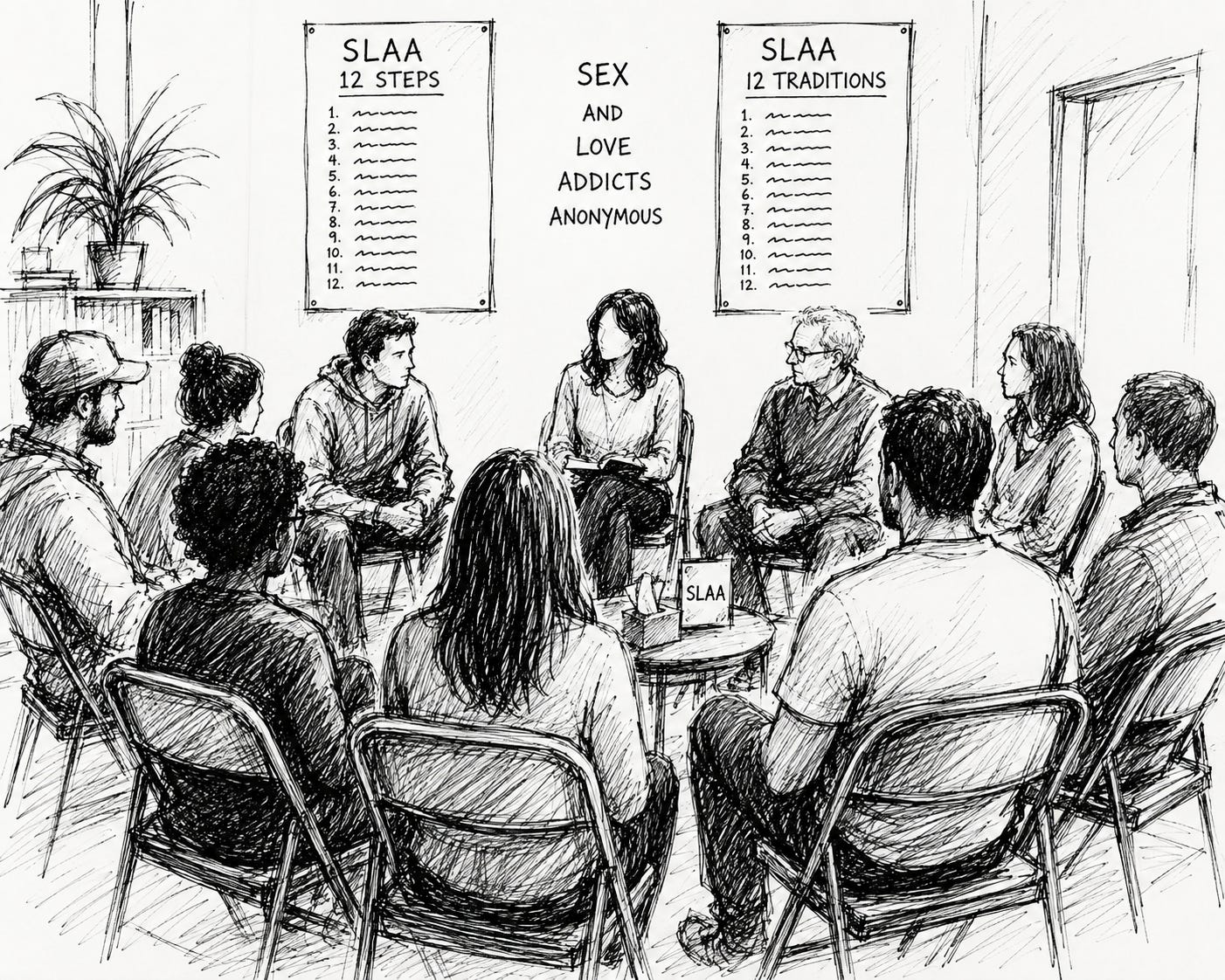
Liu also sued under consumer protection statutes, which was interesting. She claimed that SLAA was promoting unrecognized psychological concepts, which is technically true, and that this was a “deceptive consumer practice,” which is technically not true. Sex and love addiction are still not officially recognized in the US version of the Diagnostic and Statistical Manual of Mental Disorders. But still… how do you trick a consumer into a product or service that is 100% voluntary and 100% free?
The Honorable Judy H. Kim decided this was essentially an Alienation of Affection suit, and you haven’t been able to sue for that in New York State since 1935. This case was filed in March 2024 and decided in July 2026. What did Liu think was going to happen? That her fellow would see the error of his ways, slap his forehead and ask her to marry him?
I have upon occasion waited for a man to slap his forehead and declare, “Oh, no! How could I have not seen it? It was her the whole time!” It never happens.
I’m glad that our poor plaintiff sought counseling, and she might think about going to SLAA herself. Or Love Addicts Anonymous, or CODA or Alanon…. They may also lack the rigorous scientific backing she demands, but 12-step programs have more empirical confirmation than any scientific theory since evolution.
No, I am not going to get into a debate with you about evolution.